YJT Coding System for Industrial Components
YJT Coding System
for Industrial Components
A unified classification and identification scheme for industrial components
Covering fasteners, mechanical connectors, seals, pipe fittings, rigging, materials, dies and other industrial components — with an overview of the system, category descriptions, coding rules, application scenarios and an entry point to apply for a code.

YJT Code
Unified classification · identification · lookup · integration
YJT codes are used mainly for information identification, classification management, data cross-referencing and system integration of industrial components.
Submit a code application View product categoriesWhat is YJT?
The YJT Coding System for Industrial Components (copyright-registered work title: "YJT Standard System") is a classification and identification coding system for industrial components. Based on product category, structural features, use cases and common industry names, it builds relatively stable, clear, searchable and extensible identification codes for different types of industrial components.
YJT covers fasteners, mechanical connectors, anchors, seals, pipe fittings, rigging, mechanical parts, materials, dies and other industrial components. YJT does not replace national standards, industry standards, local standards, association standards, or enterprise standards lawfully formulated and implemented by enterprises. Instead, it provides a unified classification and identification method for products that are widely used in the market but often expressed inconsistently or lack a unified identification number.
For engineering design, procurement and quotation, supplier catalogs, industrial e-commerce, CAD databases and ERP/PLM systems, YJT codes can serve as a foundational tool for product identification, classification management, data cross-referencing and data mapping.
In one sentence
YJT Code gives industrial components a unified digital identity.
Full name
YJT Coding System for Industrial Components
Background
Data compilation dates back to 2010; systematic organization began at the end of 2022; by 2025 a complete documentation and database system had taken shape.
Name origin: Your Joint Tag
"YJT" comes from "Your Joint Tag", meaning "your connection identifier" — the idea that every industrial component should have a clear, unified and traceable "industrial ID". The naming reflects GlobalFastener's ongoing work in industrial standardization, information collaboration and digital applications.
Your
A shared identification tool for users, engineers, buyers, suppliers and industrial platforms.
Joint
Focused on the relationships between connection, fastening, assembly, sealing, support and industrial components.
Tag
Through unified codes, it gives components an identifiable, searchable and cross-referenceable digital tag.
The YJT name is not just a brand identity; it also represents GlobalFastener's continued exploration of industrial standardization, information collaboration and digital applications.
What problems does YJT solve?
In fasteners and industrial components, the same product may have many names across regions, companies and platforms. Some products are in high demand yet lack a clear unified identification number. Inconsistent descriptions among suppliers, buyers and engineers easily cause quotation errors, drawing misunderstandings, repeated data work and systems that are hard to interconnect.
Inconsistent names
The same component may have industry slang, internal company names, platform names and Chinese/English differences.
Inconsistent classification
Different suppliers or platforms classify similar products differently, hindering search, filtering and data work.
Drawings vs. procurement mismatch
CAD drawings, BOM lists, purchase requests and supplier quotes lack a stable identifier to link them.
Systems hard to interconnect
ERP, PLM, PDM, MES, e-commerce platforms and industrial databases need a unified product mapping basis.
Non-standard parts hard to manage
Some commonly used parts are not fully covered by formal standards yet are widely used in procurement and assembly.
High cross-language communication cost
Differences in Chinese/English names, supplier descriptions and regional wording affect international trade and cross-border supply chains.
Core value
YJT Code targets data organization, product identification, supply-chain collaboration and system integration for industrial components.
Unified classification
Builds a category directory by product type so users can quickly identify which category a product belongs to.
Unified identification
Links names, uses, structural descriptions, images, drawings and documents to a code.
Supports applications
Users can submit product information to apply for a new code or supplement an existing one.
System integration
Supports data mapping across CAD, ERP, PLM, PDM, e-commerce platforms and industry databases.
How is a YJT code structured?
A YJT code uses the basic structure "YJT + code digits". The digits are usually four to five long: the first two indicate the product category, and the following digits distinguish specific product series, structural forms or application types.
- Number of code digits
- Usually four to five
- Category prefix
- Indicates the product category
- Following digits
- Distinguish product series, structural form or application type
Each YJT code can be used together with a name, product description, typical use, product images, drawings, 3D models, dimensional parameters, and related standards or references.
In this way, a YJT code is not just a number — it can become a foundational entry point for organizing, searching and integrating industrial component information.
Code examples
| YJT Code | Name | Description | Typical use | Image |
|---|---|---|---|---|
| YJT1019 | Hex Washer Head Concrete Screw Anchor | A self-tapping concrete screw with a hex washer head that taps its own thread directly into a pre-drilled hole; no expansion sleeve required. | Fastening brackets, rails and equipment to concrete or masonry base materials. | 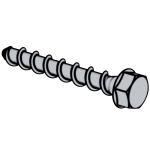 |
| YJT15004 | Metric Male NBR-Seal Hollow Hex Plug | Metric male-thread plug with a hex socket drive and an oil-resistant NBR seal ring for reliable sealing. | Sealing ports in hydraulic and pneumatic systems to prevent leakage. | 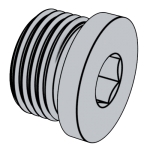 |
Product categories
The YJT Coding System for Industrial Components currently plans the following 21 product categories, with room for ongoing expansion.
Bolts / expansion anchors
Hex bolts, flange bolts, expansion anchors, etc.
Studs
Studs and double-end stud connectors.
Nuts
Hex nuts, flange nuts, lock nuts, etc.
Screws
Self-tapping screws, machine screws, socket screws, etc.
Threaded inserts
Metal inserts, wire thread inserts.
Washers
Spring washers, flat washers, etc.
Retaining rings
Open retaining rings, E-clips, etc.
Rivets / rivet nuts
Blind rivets, closed-end rivets, rivet nuts, etc.
Nails
Industrial nails such as steel nails, plastic nails, etc.
Seals
Sealing discs, plugs, O-rings, sealing washers, etc.
Connectors
Ball joints, clevis joints, etc.
Pipe fittings
Hydraulic fittings, compression fittings, etc.
Plugs
Hex socket plugs, sealing plugs, etc.
Clamps & clips
Pipe clamps, hose clamps, fastening clips, etc.
Rigging hardware
Eye bolts, shackles, wire rope clips, etc.
Mechanical parts
Leveling feet, plungers, indexing balls, etc.
Indexing parts
Index plungers, positioning pins, index plates, etc.
Pins
Spring pins, dowel pins, cotter pins, etc.
Keys
Parallel keys, woodruff keys, taper keys, etc.
Tools
Special wrenches, screwdrivers, circlip pliers, etc.
Others
Special or custom parts that are hard to classify.
Application scenarios
YJT codes can be used in product selection, procurement and quotation, supplier catalogs, platform listings, CAD databases, ERP/PLM systems and supply-chain databases.
Engineering design & BOM management
Assists product identification and code referencing on drawings, product selection, BOM organization and technical document cross-referencing.
Procurement, quotation & supplier matching
Reduces quotation errors caused by inconsistent product names and improves procurement communication.
Platform data & system integration
Supports product classification, online selection, model retrieval, standard mapping and API integration.
The industry value of YJT
As manufacturing becomes more digital, intelligent and globally connected, unified expression of product data grows ever more important. With unified classification, identification, lookup and integration, the YJT Coding System provides a foundational tool for managing industrial component data.
Improve identification efficiency
Through unified codes, group together similar products expressed under different names, languages and supplier descriptions.
Promote data standardization
Serves as a cross-reference tool among enterprise product libraries, platform databases, CAD model libraries and ERP/PLM systems.
Lower communication cost
Buyers, suppliers and engineers can communicate using the same code, reducing quotation and delivery errors.
Support cross-platform use
Helps build data links among industrial e-commerce, CAD software, industry databases and enterprise information systems.
For the industrial components industry, YJT is not just a product code but a foundational tool for digital management, platform applications and cross-enterprise collaboration.
Industry Support & Cooperation
The YJT Coding System is developed and continuously maintained by GlobalFastener Inc.
The American Fastener Application Association supports professional communication, application research, standards information exchange and international industry cooperation related to the YJT Coding System.
Through this cooperation, YJT Code aims to improve the identification, classification, cross-referencing and digital application of fasteners and other industrial components.
Apply for a YJT code
If your product does not yet have a matching YJT code, you can submit an application. Please provide the product name, structural description, use, images, drawings, material, dimensional range or reference standards where possible, to aid review and classification. Submitting materials does not mean the platform certifies or endorses the product's quality, technical performance, intellectual property status or standards compliance. YJT organizes, classifies and codes the related materials; it does not change the product quality and standards-compliance responsibilities that production and business operators must bear under the law.
Submit a code application- The user submits product information and contact details
- The back office checks the completeness of the information
- It is determined whether an identical or similar code already exists
- The product category and code information are confirmed
- Once approved, it is published or updated on the official site
Notes on using YJT
YJT codes are used mainly for information aggregation, classification management, product identification and system integration of industrial components. They are not a product quality certification, do not guarantee product performance, and should not be used directly as a transaction voucher or acceptance basis.
Does not replace technical review
In actual procurement, design, transactions and engineering use, users still need to reconfirm based on the specific product's dimensions, material, performance, standard basis, application conditions and supplier documentation.
Not a quality certification
YJT helps users find products faster, describe products more accurately and cross-reference documents more easily — it does not replace quality verification, sample confirmation, contract terms or acceptance standards.
Does not replace product implementation standards
YJT codes and their accompanying technical materials are used mainly for product identification, classification, lookup and document cross-referencing. They do not replace product standards that production and business operators are legally required to implement or disclose. Production and business operators should confirm the applicable national, industry, local, association or enterprise standards according to the actual product, and fulfill the corresponding standardization obligations in accordance with the law.
Intellectual property & brand notice
YJT codes are for product classification, dimensional indexing and procurement reference only, and do not represent product certification, patent authorization or brand authorization. Referenced brands and models are used only to identify similar or compatible products; the related rights belong to their respective owners.
For product information submitted by suppliers, the drawings, specifications, material descriptions and intellectual property status should be true, complete and lawful. The platform can provide code display, information cross-referencing and communication assistance, but buyers and sellers should still complete final confirmation based on contracts, samples, technical documents and acceptance standards. Submitting materials does not mean the platform certifies or endorses the product's quality, technical performance, intellectual property status or standards compliance. YJT organizes, classifies and codes the related materials; it does not change the product quality and standards-compliance responsibilities that production and business operators must bear under the law.
Frequently asked questions
Helping users quickly understand the positioning, uses and limits of the YJT Coding System for Industrial Components.
Copyright & cooperation
The YJT Coding System for Industrial Components is originally designed and continuously maintained by GlobalFastener.
Open cooperation directions
Industrial platforms, CAD software, ERP/PLM systems, enterprise databases, industry media and suppliers are welcome to get in touch to use the system and advance industrial component data standardization, model library building, supply-chain matching and cross-platform data integration.
Take part in building YJT codes
If your product does not yet have a matching code, you can submit information to apply for a new code or supplement an existing one.
Apply for a code Back to top